
Ravello
An interesting town perched high above the Amalfi Coast a favorite destination for many
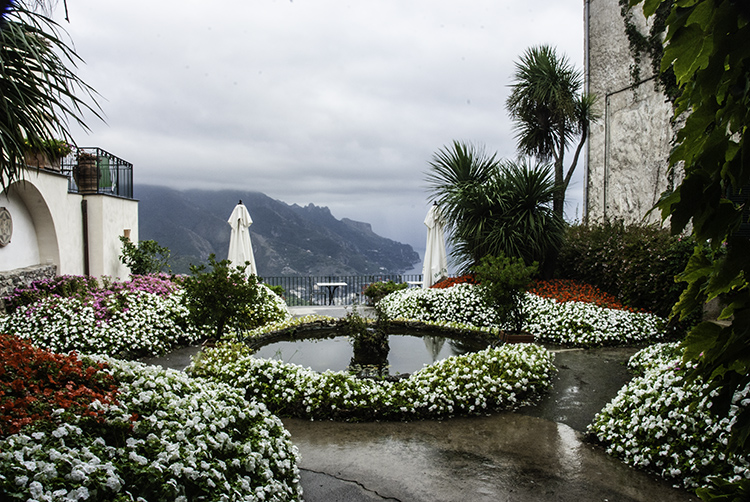
Ravello
Ravello, a beautiful town on the hills high above the Amalfi Coast. Founded between the 4th and 5th centuries it was a refuge against barbarian invasions. By the 9th Century, Ravello grew to have a place of considerable prominence as part of the maritime Republic of Amalfi. Money from producing and trading wool flued growth. Today, Ravello is a UNESCO World Heritage Site, attracting visitors with its scenic location and historical charm.
One of the town’s main attractions is the Duomo di Ravello, a cathedral renowned for its “Pulpit of the Gospels” created in 1272. There is also the iconic Villa Rufolo, known for its beautiful gardens and stunning views, as well as the Villa Cimbrone, another historic estate famous for its “Terrace of Infinity” - both of these villas speak back to the time of Ravello’s rich past. Photographers, your time in Ravello will be well rewarded. There are gardens and medieval architecture to capture.
On our frequent trips to Amalfi, we typically take the bus up to visit Ravello. On the last two recent trips, in 2010 and 2009 Glenn walked up from the Hotel Villa San Michele to Ravello, taking what seemed to be endless steps to the steep vertical climb. It is a challenging but rewarding walk. There are great views of the coast. Of course once you arrive at the top, stop and enjoy a drink in the piazza.
Ravello is situated about 5 km from Amalfi, up on the mountain overlooking the coast from Maiori to Amalfi. Founded in the 5th or 6th century, Ravello was at its peak during the X and XI century. Reports indicate that in the 12th Century there were over 25,000 people living in Ravello.
You could drive up the windy, narrow road, stopping, pulling over to the side so close to the edge of the cliff you will stop breathing, only to find parking is scarce but available just outside Ravello. Or, you can take one of the frequent buses and hang on for your life as you try to stand as the bus makes its way up the winding steep road. I know people who have walked the road, not recommended! The key thing is to get there in condition that you can enjoy yourself. But, there are stairs from Amalfi up the hill to Ravello. Even I have walked those a few years ago. Going up is easier than coming down.
The Duomo
Sitting on the main piazza of the town is the Duomo, dedicated to San Pantaleone, is from the XI century, and was built by Bishop Orso Pavico. The entrance doors are similar to those of Amalfi, in bronze, made in Constantinopoli in the XII century. In the church there is a museum and included is a marble creation of Niccolò di Bartolomeo, XIII century and XII century representation, with mosaic decoration, of Giona eaten by Pistrice.
Beautiful architecture of the Villa Rufolo
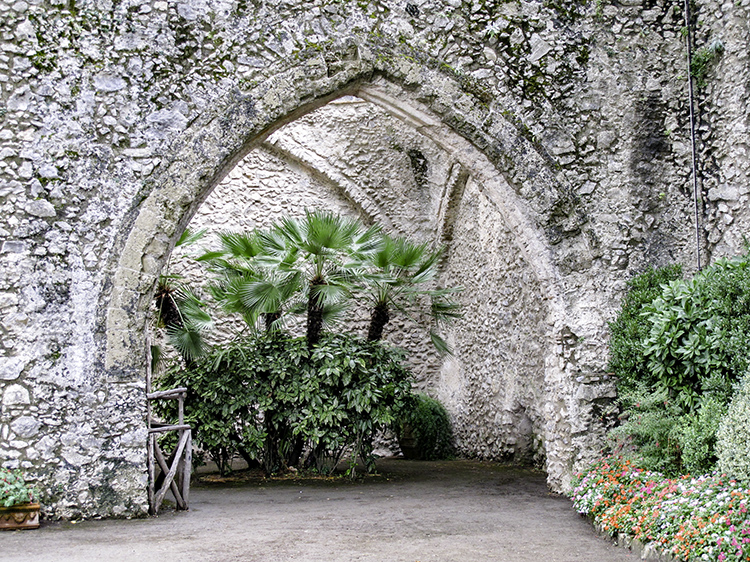
photo: mytravellinglens.com
Villa Rufolo
A historic building, located just off the main piazza, we can never see this villa too often. It was built in the 13th century for the Rufolo family, very prosperous merchants. Over the centuries, the villa changed hands several times, passing to the Confalone, Muscettola, and d’Afflitto families.
In the mid-19th century, it was sold to Francis Neville Reid (of Scotland) who completed restoration giving us the building we see today. But at various times this was a home of various Popes as well as King Charles I of Anjou.
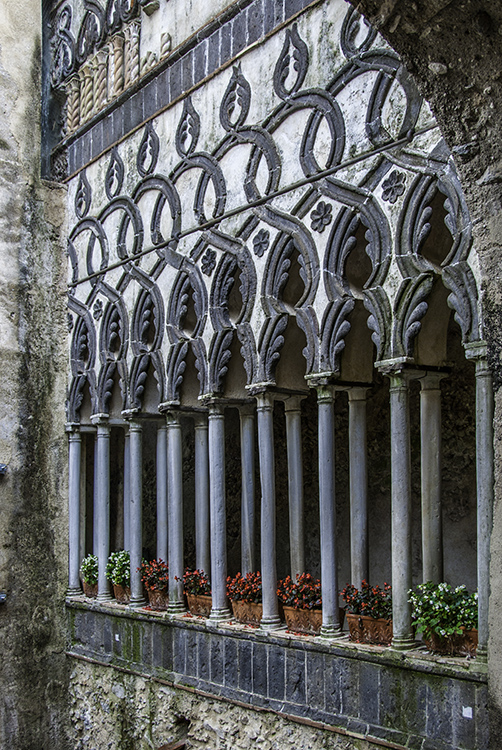
You enter the villa is entered through an arched entrance tower, leading to a yard with the Torre Maggiore. The tower faces the bell tower of the cathedral in Ravello. Among the rooms of the villa, a large courtyard elevated like a cloister and some rooms forming a small museum are very interesting.
The German opera composer Richard Wagner visited the villa in 1880 and was so inspired by its beauty. He was the last resident of the villa. In commemoration of Wagnar, there is a Wagnerian concert hosted each year in the lower garden of the villa.
Villa Cimbrone
The unforgetable experience and view
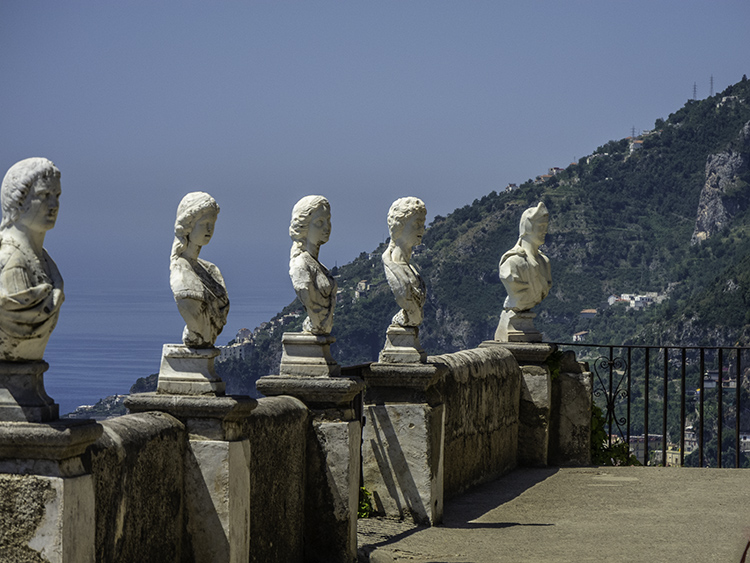
photo: mytravellinglens.com
You will never forget standing on the Terrace of Infinity and looking out over the Amalfi Coast and the sea! Take a walk through the town, to reach the Villa Cimbrone which has very impressive gardens.
Villa Cimbrone dates back to the 11th century when it was a fortified residence. Over time, it underwent transformations under various noble families. In 1904, the villa was acquired by Ernest William Becket, an English nobleman later known as Lord Grimthorpe. He embarked on an extensive renovation project, adorning the gardens with an exquisite collection of sculptures and adding the famed Terrace of Infinity, fountains, and temples.
The villa has entertained many famous personalities, including Winston Churchill, Gore Vidal, Tennessee Williams, Graham Greene, Richard Wagner, Jackie Kennedy, and Coco Chanel.
Today, the villa is owned by the Vuilleumier family. Visitors to Villa Cimbrone can explore its extraordinary gardens and take in the vistas from the famous Terrace of Infinity. Other highlights include the cloister and crypt, which are the first things you see upon entering1. The cloister is medieval, with some Renaissance flourishes.
Nobel families moved to the top of the hill to build their fortified homes to be free of being part of Amalfi. They erected fortified walls around the town and began building various patrician villas. The villas such as Villa Rufolo and Villa Cimbrone, were symbols of wealth and power, and they played a significant role in the town’s history.
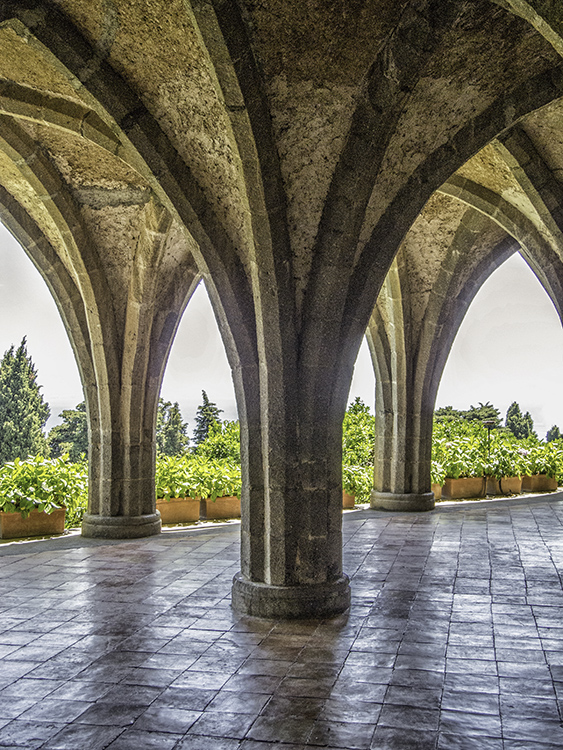
Cloisters, Villa Rufolo
Even if you took the bus up, you will remember the crowds and you just may want to walk off the great lunch. You would not walk the road, but take the stairs down to Amalfi. The only hard part about walking down is the pressure on your knews as you "brake" all the way down. But stopping and enjoying the view is part of being on the Amalfi Coast.
