
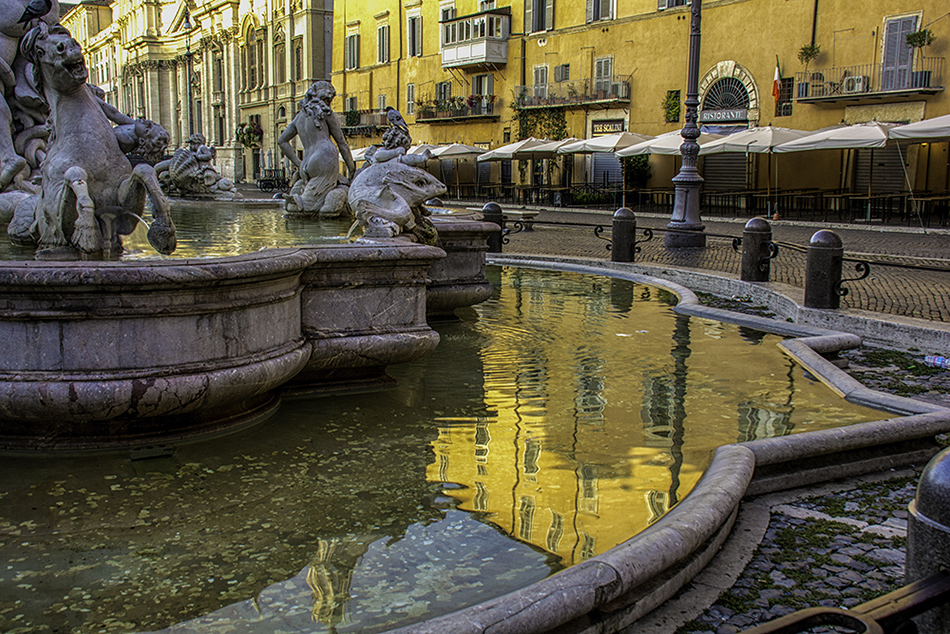
The eternal city.
Called Monti (mountains) as area includes the Esquiline, Viminal, and Quirinal Hills—three of the Seven Hills of Rome. Narrow winding streets and historic sights.
Domus Aurea: Former palace of Nero with opulence and frescoes. The entrance to Nero’s Golden House, is across from the Colosseum. Go to Parco del Colle Oppio, off via Nicole Salvi, it is two or three steps down from the entrance. Built in I AD, the imperial palace extended over three of the seven hills of Rome. A number of the sections are open to the public. You will see high ceilings, long corridors, and painted walls.
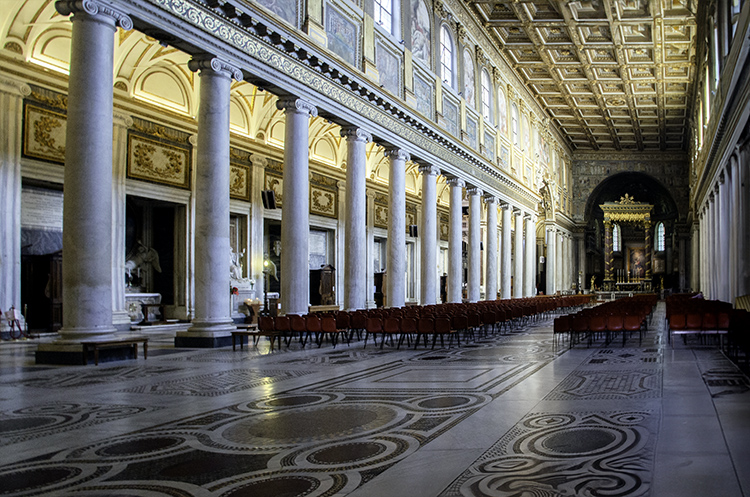
Basilica of Santa Maria Maggiore: on Esquiline Hill a few minutes from Termini Station. The oldest Christian church in Rome and noted for its beauty. The church is part of Vatican land (versus Rome). Stunning basilica has intricate 5th and 13th Century mosaics. The bell tower at 250 ft is the highest in Rome.
Church of St. Peter in Chains, three blocks from the Colosseum and holds the chains that are said to have bound Saint Peter when he was in a Jerusalem prison. Also of note is a statue of Mosses (1515) carved by Michelangelo.
Arch of Gallieno is a well-preserved ancient arch that was originally the Porta Esquilina. Made of travertine this was a gate through the old Servian Walls of Rome. It is located on a narrow side street. From the Piazza Vittorio Emanuele, leave the piazza at the northern end, go down Via dello Statuto and then take first right at Via Pellegrino Rossi. Follow until the end and go left on Via di San Vito to walk through the Arch. Marcus Aurelius, a member of the imperial household, dedicated the arch to Emperor Gallienus.
Church of Santa Prassede is famous for some of the most beautiful mosaics in Rome.
Bordering Monti, Trevi’s name likely originates from an ancient intersection of three streets.
Trevi Fountain is an iconic fountain. Toss a coin over your shoulder and make a wish. This is very true and Karen and I are living proof. If you throw the coin over your should and make a wish to return to Rome ... well it has been almost every year for over 35 years now, and counting. We are not the only people throwing money in the fountain, about 3000 Euros a day are pick up from the fountain. In 1730, Pope Clement XII held a contest to re-design an existing fountain. Work was completed in 1762. The fountain, carved out of Travertine stone, depicts Oceanus, god of water, in the center niche, flanked by Gods Abundance and Salubrity. Below the gods are a number of hippocampus and tritons adding symmetry to the fountain. The Fountain is one of the most famous fountains in the world. Despite the crowds, put it on your list.
Palazzo Barberini - a 17th-century palace (1625 to 1633), residence for the wealthy Tuscan Barberini family. Now, houses the Galleria Nazionale d’Arte Antica that includes work of Raphael, Tintoretto, Caravaggio, Bronzino, Gian Lorenzo Bernini, Guido Reni, and Pietro da Cortona.
Quirinal Palace - one of the three official residences of the President of Italy. Built in 1583 as a summer residence for the Pope. It is open for guided tours of the state apartments and gardens. There is also a museum that tells the story of the movement that led to the unification of Italy.
Piazza di Spagna at the base of the famous Spanish Steps, the Palazzo di Spagna has the Embassy of Spain to the Holy See. The Spanish steps connect a French church at the top of the stairs to the Embassy of Spain at the bottom. At the foot of the stairs is the Fontana della Barcacia, a baroque fountain sculpted by Pietro Bernini and his son Gian Lorenzo Bernini. There is also an Egyptian ancient obelisk and the Keats-Shelley Memorial House, the final home of Romantic poet John Keats.
Centered around the Column of Marcus Aurelius.
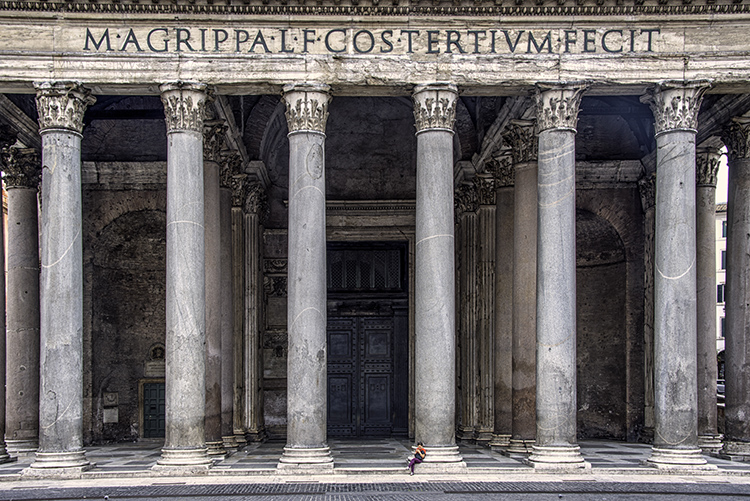
Pantheon - : A marvel of ancient engineering (25 and 27 BC). The present building is the result of restructuring (126 - 128 AD) - even the restructuring sets this building as a massive ancient structure. Building thought to have been a temple for Roman gods. Today it is an active church. While the entire building is impressive, the dome, and the occulus, the round opening in the dome, the only source of light for the interior, are impressive beyond words. There are monumental tombs set into the walls. You now have to purchase a ticket to enter.
Palazzo Montecitorio - another home for a the family of a Pope. Now the seat of the Italian Chamber of Deputies, it was designed by Gian Lorenzo Bernini for Cardinal Ludovico Ludovisi, nephew of Pope Gregory XVI. When it was finished, Pope Innocent XII put in place anti-nepotism policies, and according the palace was to be used for public and social functions. In 1696 the papal law courts were housed here. The obelisk of the Solarium Augusti, now known as the Obelisk of Montecitorio, was installed in front of the palace by Pius VI in 1789. The interior was extensively renovated with only the original facade in place. The courtyard, wings and rear of the palace were demolished. The four red-brick and travertine towers on the corners werre added. The Palazzo Montecitorio is open to the public for guided tours the first Sunday of the month.
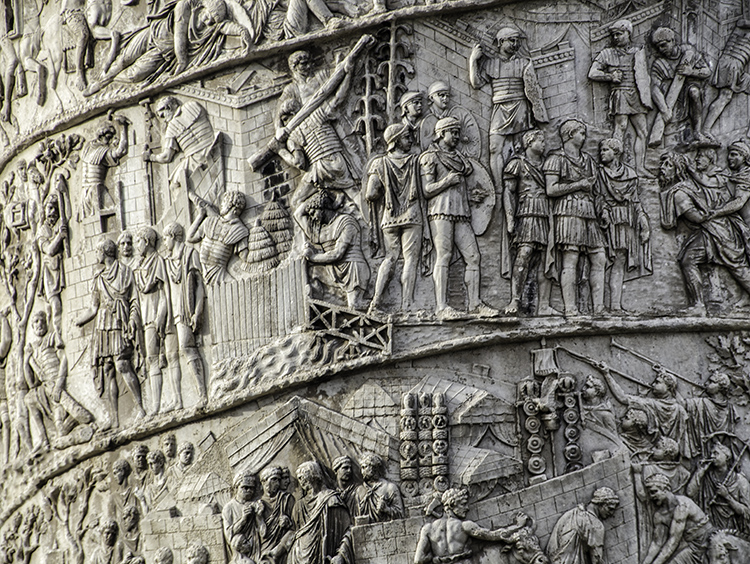
Piazza Colonna - is where the towering marbel Column of Marcus Aurelius which has stood there since 193 AD. The statue of Saint Paul was installed at the top of the column in 1589 by Pope Sixtus V. The fountain was installed in the 16th Century, with restoration and dolphines added in 1930. On the north side is the 16th Century Palazzo Chigi, and is now the official residence of the Prime Minister. On the east side, the Galleria Alberto Sordi, a shopping arcade (1922). On the south side, there is the 18th Century papal post office (Palazzo Ferrajoli), which later became a private palace. Today it is used for cultural events. On the west side, there is Palazzo Wedekind, 1838 bank, later a newspaper office. The Roman columns taken from an ancient city, Veii, located in the area of Etruria about 16 km northwest of Rome.
Galleria Alberto Sordi - while Milan, Naples, Genova and other cities in Rome has grand steel and glass domed shopping arcades, Rome has this galleria. On our 2023 visit to Rome work was underway to renovate. The glass doors were removed to eliminate the feel of wallking into a store, but to accent that you are entering a grand space. I look forward to seeing the other changes on our next visit to Rome.
Via del Corso is a historic street from the Piazza Venezia to the Piazza del Popolo. Shops, cafes line the street and therre is always a buzz. The sidewalks, however, are very narrow so be prepared to manouver in the crowds.
Named after the Field of Mars, once a military training ground. From the Middle Ages on this has been a densely populated area. During that time, all newly elected Popes crossed this area on the trip from St. Peter's Basilica to the offical residence for Popes, at St. John in Lateran.
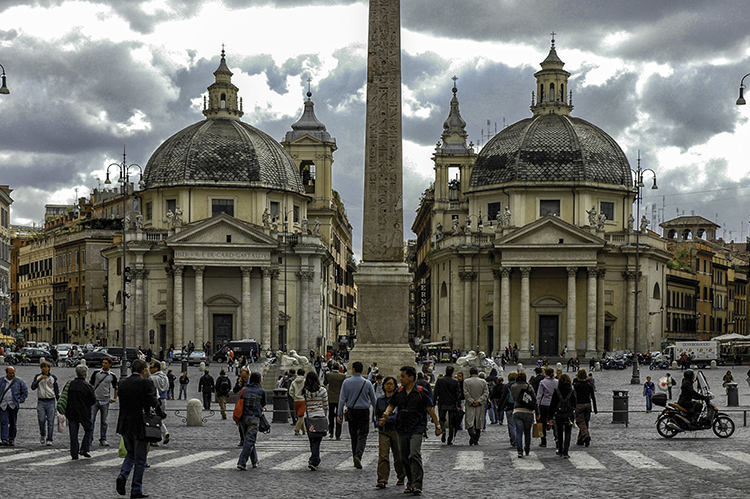
Piazza del Popolo - the piazza (1811 to 1822) takes it name from the poplars and sits at the northern gate of the Aurelian Walls. In Roman times, this was the gateway to the very important road to the north - Via Flaminia. The Egyptian Obelisk of Seti I, was brought to Rome in 10 B.C. and is the one of the oldest obelisks in Rome. As a photographer I am always trying to get the ultimate photograph of the twin churches of Santa Maria in Montesanto (left, 1662–75) and Santa Maria dei Miracoli (right, 1675–79)3. On Sundays Via del Corso is closed to traffic and you, and thousands of Romans, can walk along Via del Corso to the Piazza del Popolo. It is the thing to do.
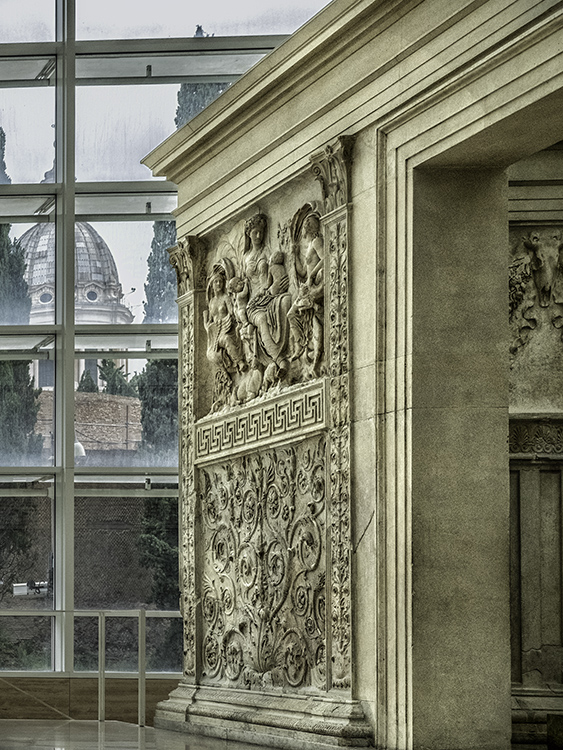
Ara Pacis - an impressive building. On one of our visits there was a fasion exhibition celebrating designed Valentino. It was exciting. The building is named for and built top hold the ancient altar dedicated to peace. The alter, celebrates Pax, the Roman goddess of Peace (30 BC), originally stood outside of Rome, in a corner of the Campus Martius. Over the many years it became buried under four meters of silt and was forgotten. That probably saved it. Dug up in 1938 it was reassembled and placed in the Ara Pacis. The building was renovated in the 21st century.
Villa Borghese - more property of the Popes and their families. The 200 acre park (1606 - 1633) was a private estate of Cardinal Scipione Borghese, the nephew of the Pope Paul V. The Villa Borghese, today, holds museums and gardens with a range of monuments, fountains and even a small articial lake where you can rent a row boat. In 2023 I spend a morning in the park. It is massive. I mapped out a walking route that took in some of the sights. What I enjoyed the most was being away from the crowds of the city. I entered the park from the Piazza Popolo, and then came back down to the city centre via the Spanish Steps.
Mausoleum of Augustus - reopened in 2021 after 14 years of restoration work, and basically closed again in 2022 for further work. A corridor runs from the entrance to where the golden urns would hold the family ashes. The two pink granite obelisks originally at the arched entry were removed years ago and stand near the Basilica of Santa Maria Maggiore and the Quirinal fountain. This is a future goal to see.
Named after the Ponte Sant’Angelo, the famous bridge adorned with angel statues connecting Rome to Vatican City.
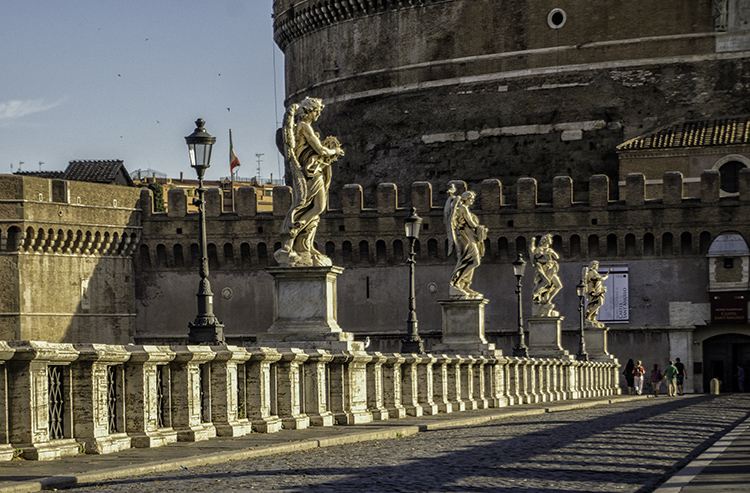
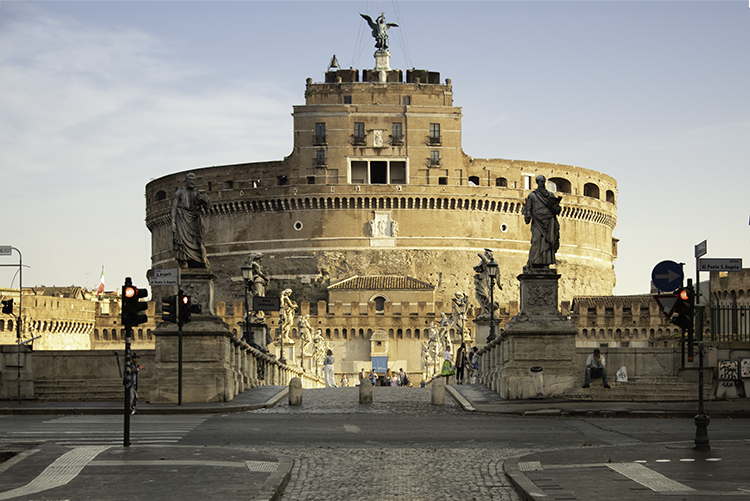
Ponte Sant’Angelo - built in 134 AD as the Pons Aelius to cross the Tiber River for access to Hadreian's mausoleum. In the Middle Ages it was the Pons Sanctri Petri as this was the route for pilgrims to reach St Peter's. In the 16th Centre Pope Gregory named both the bridge and the castle Sant'Angelo. Of the five bridge arches, three are original Roman arches. Two replaced after a massive flood. Photographers, this is one of the places to be in the evening for iconic views of St. Peters and the Tiber River at sunset.
Via dei Coronari- A charming street lined with antique shops.
Centered around Rome’s most famous square, Piazza Navona.
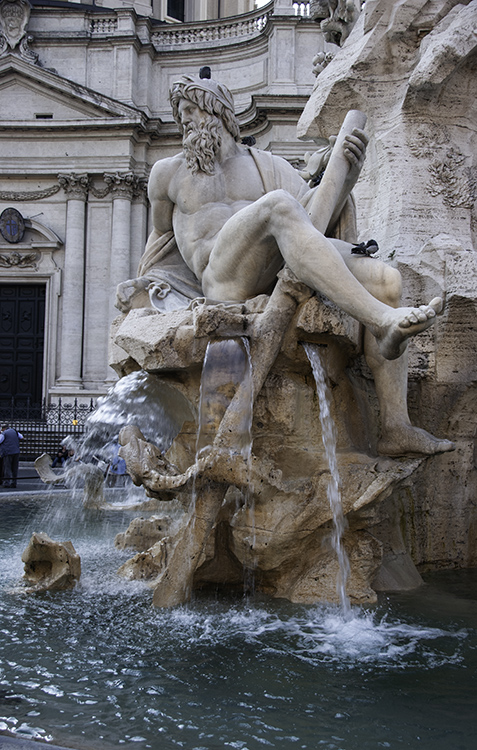
Piazza Navona - An elegant square with Bernini’s Fountain of the Four Rivers. It was built on the site of the 12 AD Stadium of Domitian. Over time, the name “in agone” (games) changed to “Navone” and eventually to "Navona". For a while it was the market square of Rome, then grander plans for the piazza took hold. In the 17th century, it became a showcase for Baroque design, with work by Bernini and Borromini among others. I can never get enought of the central Fountain of the Four Rivers with the massive statues, the fountain of Neptune, and the church of Sant’Agnese in Agone (with the original ancient name).
Sant’Agnese in Agone: A stunning Baroque church on Piazza Navona. No photography is allowed in the church.
Palazzo Braschi: it now houses the Museum of Rome, but I hate to repeat myself, built for a family, a nephew of Pope Pius VI. The Braschi family sold it to the Italian state in 1871, it became the state quarters of Benito Mussolini. After World War II it became a home for displaced families until 1952 when Museo di Roma moved into the building.
Campo de’ Fiori: A lively market square by day and a vibrant nightlife spot. That sits on the boarder of the R VI and R VII Rione. The small stores around the square are great for food shopping also.
Nestled between the Tiber River and the historic center.
Palazzo Farnese and the Piazza Farnese: the square was transformed when in the 16th Century Cardinal Alessandro Farnese, who later became Pope Paul III, bought and demolished houses in the area to build his palazzo. The massive granite basins in the piazza were moved from the Roman Baths of Caracalla. The magnificent Renaissance palace is now the French Embassy and access is only by guided tour which have to be pre-arranged - so basically there is no general access to the Palazzo.
Santa Maria dell’Anima : A Gothic church with Flemish art, a German National church within Rome. It is open from 9:00 am to 12:45 and then 3:00 to 7:00 pm.
Santissima Trinità dei Pellegrini is one of my favorite churches of Rome. Established in 1540. Since 2008, it has been entrusted to the Priestly Fraternity of St. Peter (FSSP), a society dedicated to the celebration and preservation of the Tridentine Mass - which is the 1962 form of Mass only authorized under certain conditions for use in the Catholic Church.
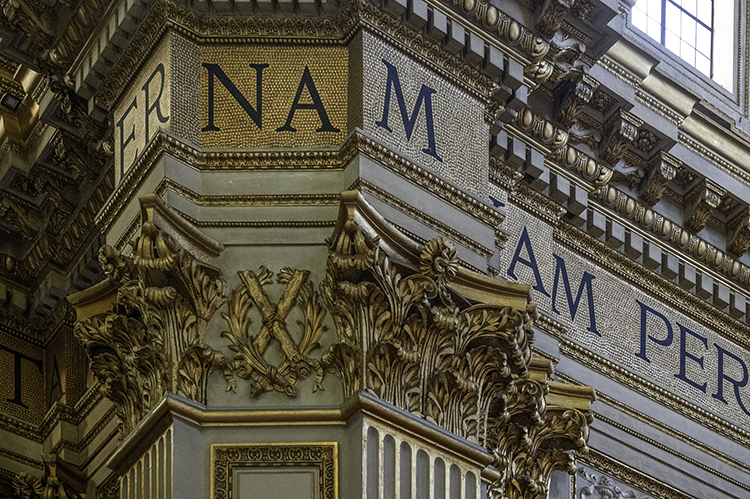
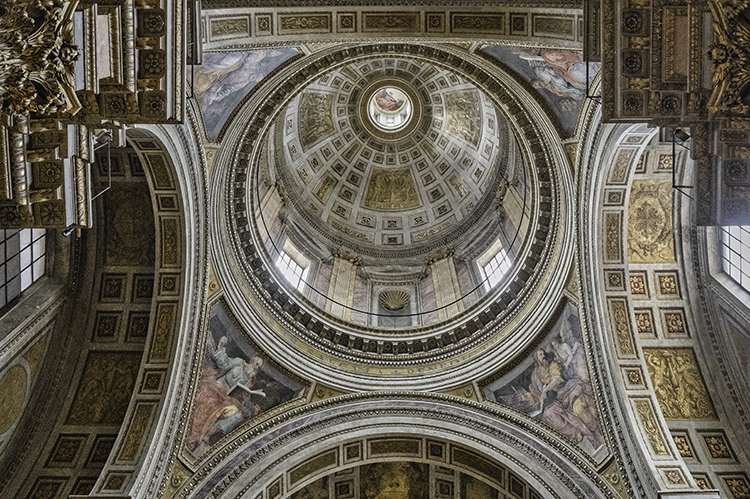
Sant’Andrea della Valle - A beautiful Baroque church which I have walked by so many times but in 2023 popped in to see what was inside. Impressive. Second highest dome in Rome following St. Peter's.
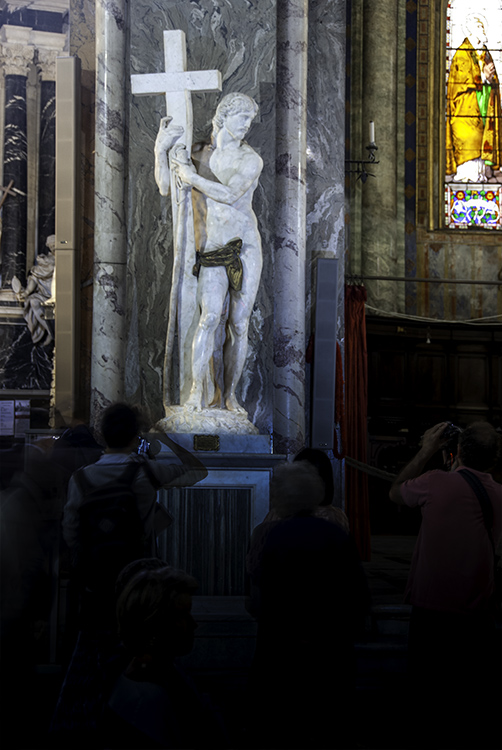
Santa Maria Sopra Minerva: A Gothic church with statue bu Michelangelo, Christ the Redeemer.
Piazza della Minerva: Home to an obelisk and Bernini’s Elephant and Obelisk sculpture. Lots of history and lore about the symbolism of the elephants flicking tail.
Palazzo della Sapienza: A Baroque palace housing the University of Rome.
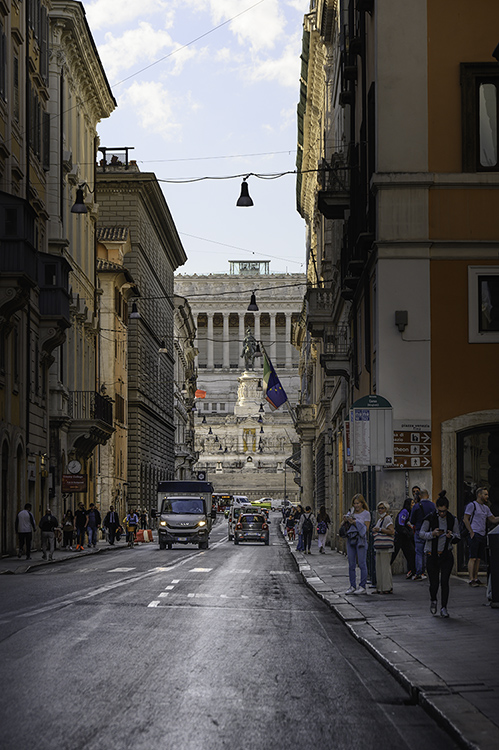
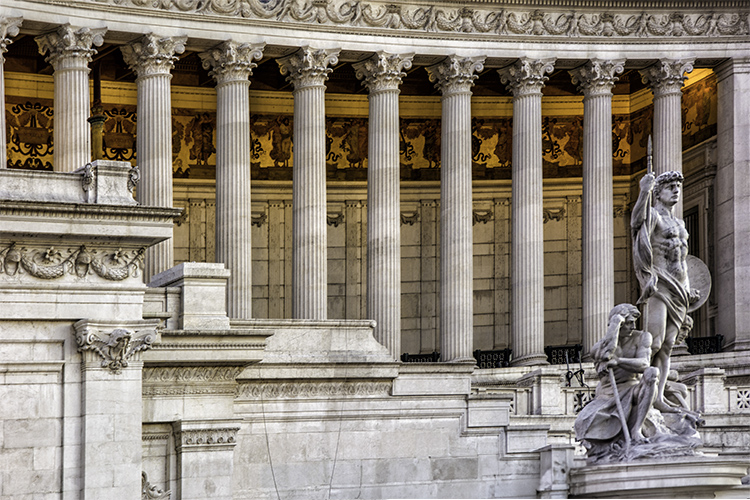
Altare della Patria (Victor Emmanuel II Monument): A massive monument. Walk through the interior or this large structure, tour the military museum, and then from the outside buy a ticket and take the elevator to the roof for great views of Rome.
Encompasses the Capitoline Hill and the Roman Forum.
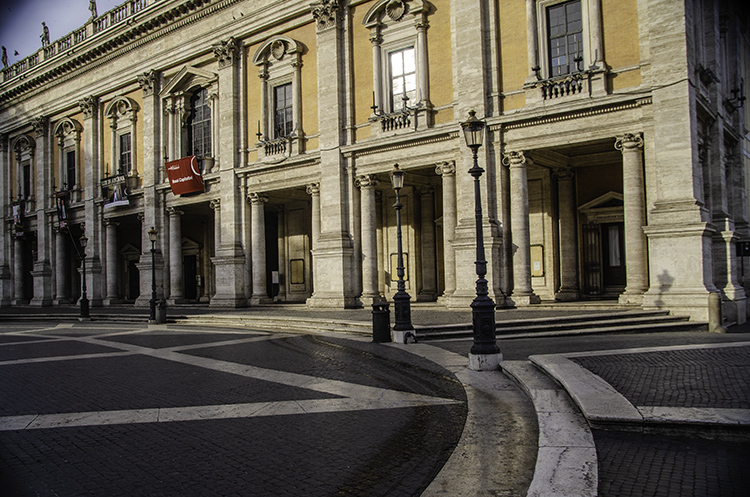
Capitoline Hill: Michelangelo’s Piazza del Campidoglio (16C) designed at the request of Pope Paul III who renovated the area in preparation for a visit of Empereor Charles V of Habsburg to Rome. The Piazza is bordered by the Palazzo Senatorio, Palazzo dei Conservatori and the Palazoo Nuovo. In the middle of the square is a statue of Marcus Aurelius (copy outside, original inside the museum). The Capitoline Museums, the oldest musseum in the world, are housed in the Palazzo dei Conservatori and the Palazzo Nuovo.
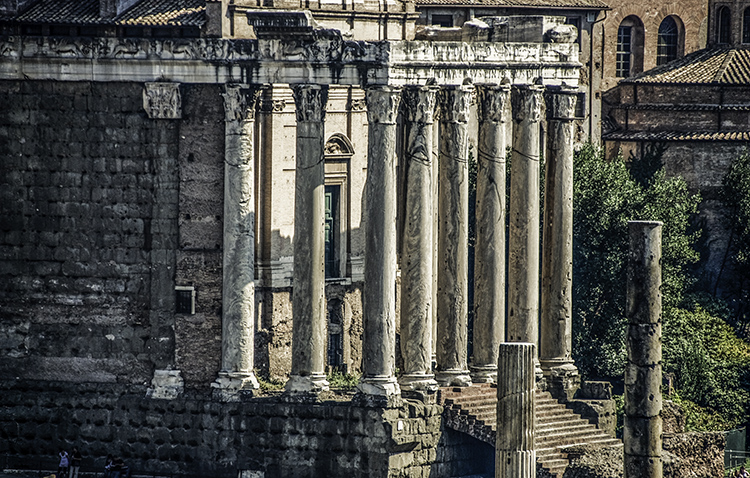
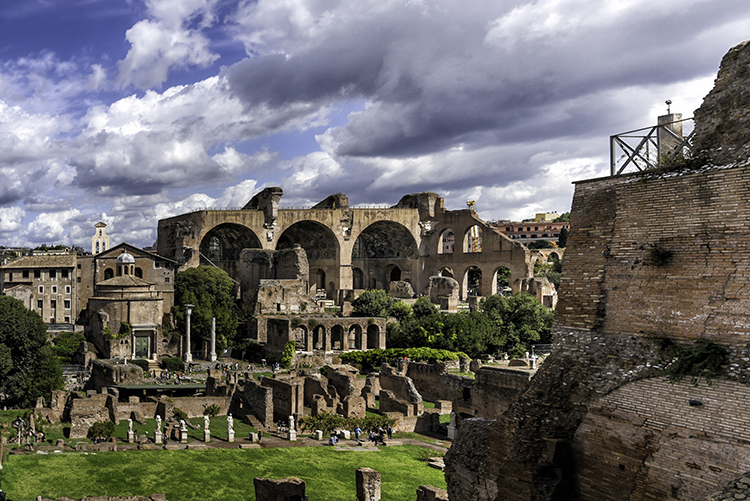
Roman Forum: Ancient ruins of temples, basilicas, and civic buildings. This was the heart of the Roman Empire. Via Sacra was the main street of ancient Rome. The Arch ot Titus is the oldest of the Roman triumphal arches. On three soaring vaulted arches remain of the Basilica of Constantine, which was at the time, the largest building in the Forum.
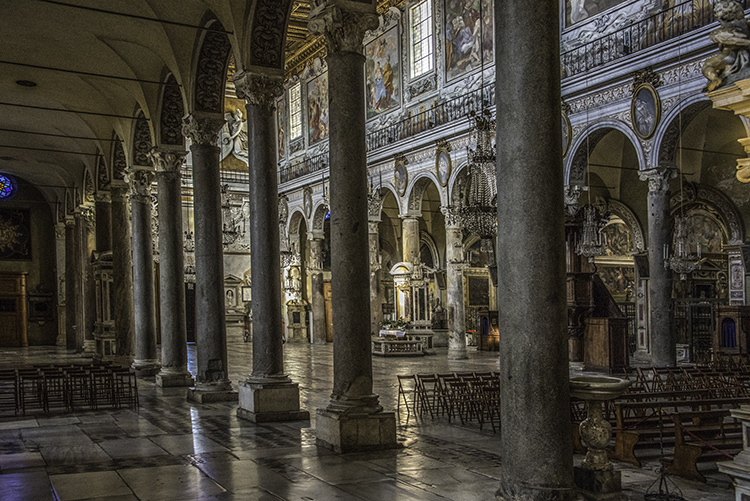
Santa Maria in Aracoeli: A 13th C hilltop church with a breathtaking view. The stairs you climb will be your personal test of really wanting to see the interior. The climb is worth it. I enjoy this church each time I enter it. The columns along the central nave, the chandeliers and the gold guiled wood roof. Lots to see and appreciate.
Sant’Angelo is the smallest of all the Rioni of Rome. It lies along the course of the River Tiber, near Tiber Island. Historically, it has experienced frequent flooding from the river.
Notably, Sant’Angelo was once home to the Roman Ghetto which houses the second-oldest Jewish Ghetto (1555) after that in Venice. The most important building is the Tempio Maggiore, the Synagogue, the Theatre of Marcellus (11C) which was the first theatre in Rome, and the Portico of Octavia. We have noticed that over the last few trips the beautiful Fountain of the Turtles is becoming more popular. There is no public access to the Theatre of Macellus, just admire it from the outside.
Ripa stretches along the left bank of the Tiber River.
Porta Portese: A historic gate and the site of the famous Sunday flea market.
Santa Maria in Cosmedin: Home to the Bocca della Verità (Mouth of Truth). The church built in the 6C, expanded in the 8th C and renovated in the 12th C when the bell tower was added. It is the highest medieval bell tower in Rome. The Church was decorated in 782 by Greek monks, as as result of the work was named "cosmedin" meaning ornate. I visted the church in 2023 when I thought it was finally time to see Booca della Verità - the Mouth of Truth. Get ready to stand in line with most of the time being taken by one person going up and having their friends take a photo of their hand in the mouth. You know what comes next, each person neeeds a similar photo. Well I have seen replicas of the Mouth and it was time to see the original.
Trastevere is the largest Rione in Rome. It’s famous for traditional trattorias, craft shops, and clubs.
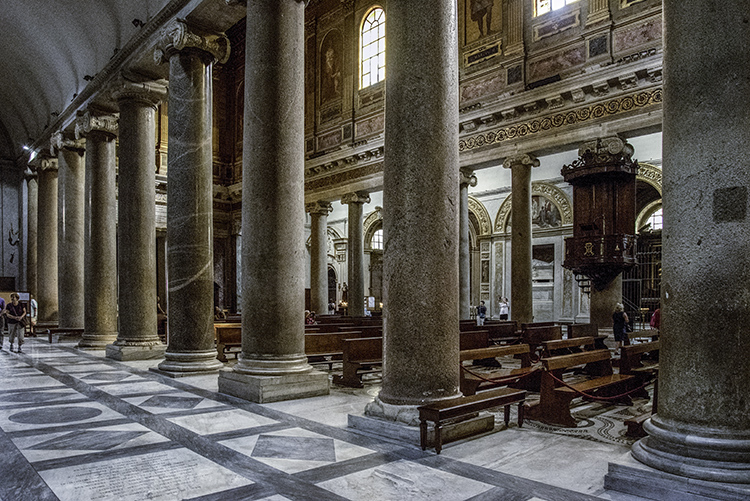
Santa Maria in Trastevere: One of Rome’s oldest churches. Everytime I walk into this church I am impressed. The mosaics, the massive columns just the feel of when you are in this church is impressive. Well worth a visit.
Piazza di Santa Maria in Trastevere: A lively square. This is the site where a miraculous fountain of oil sprang from the ground on the day of Jesus' birth. In Roman times it was part of the larger area called Campus Martius. In the Middle Ages it was a place for locals and pilgrims to meet. The fountain is one of the oldest in Rome and has been restored several times by different popes.
Villa Farnesina: A Renaissance villa with beautiful frescoes. Open Monday to Saturdays 9 to 2 and every second Sunday per month from 9 top 5.
Janiculum Hill: Within the Trastevere Rione, but far from the Piazza di Santa Maria in Trastevere, as its names implies, this is a hill on the west side of the Tiber River and outside the boundaries of ancient Rome. I was taken here by a friend I made in Rome for the view, and view it has - you look out over the domes and towers of Rome. There is a Baroque fountain, a church and the Villa Lante. It felt like Romans went there to get away from the tourists.
It stretches from the Tiber River to the Vatican City.
Castel Sant’Angelo: Originally Emperor Hadrian’s mausoleum it holds the family, as well as other Roman Emperors ashes. Emperor Aurelianus had the mausoleum be part of the new walls around Rome (Aurilian Walls) in 271 and with that it became a defensive castle for Rome. Over time it has had various uses, with being a safe house for the Popes often noted. You can tour the papal apartments. Tours are interesting as there are three things to see: Roman remains, the fortified castle and the papal apartments. It has been a long time since we went through the castel, it is time to go back.
Via della Conciliazione: The grand avenue leading to St. Peter’s. Photographers, and evening here is worth it!
Encompasses the Esquiline Hill, one of the Seven Hills of Rome.
Piazza Vittorio Emanuele II: This is the largest piazza in Rome. A large square with a beautiful garden. A visit here is like a flashback. The arrangement of the area and the design of the monumental buildings with Umbertine-style arcades surrounding it are due to the Roman architect Gaetano Koch. Just walk through the arcades, have the feel of a Rome of the past!
Rione Ludovisi, the 16th rione of Rome, Italy, is known for its rich history and beautiful architecture. The US Embassy is in this Rione, housed in the Palazzo Margherita which was the residence of Queen Margherita of Savoy.
Via Vittorio Veneto - this area is well away from the historic centre of town, but the street is known as the "heart of the Dolce Vita" and was the area for Hollywood stars in the late 1950s and early 1960s. It has cafes and historic luxury hotels.
Church of Santa Maria della Concezione dei Cappuccini - we made our way to see this church on one of our earlier trips to Rome. It houses the ancient Capuchin cemetery dating back to the first half of the 18th century and expect to see lots of bone parts in the church.
Named after the ancient Roman historian Sallust, this rione is close to Via Veneto.
There are a number of old villas and churches in the area. Most visitors to Rome, with a limited number of days, would not travel out to this Rione. It is a half-hour walk from the Piazza Venezia.
This area is above and to the east of Termini Station.
Baths of Diocletian: Ancient Roman baths, now part of the National Roman Museum. You can wonder through the halls of the baths (they were the largest in Rome). The Baths are closed on Mondays, but open on the other days from 9:30 to 7:00.
Michelangelo’s Cloister is located within the complex of the Baths of Diocletian, which is part of the National Roman Museum. The cloister, known as Chiostro di Michelangelo, is a significant part of the museum and is a must-visit when you’re exploring the Baths of Diocletian. The cloisters are the charterhouse of the church of Santa Maria defli Angeli e dei Martiri. We spent time in the cloisters
Porta Pia: An impressive gate designed by Michelangelo.
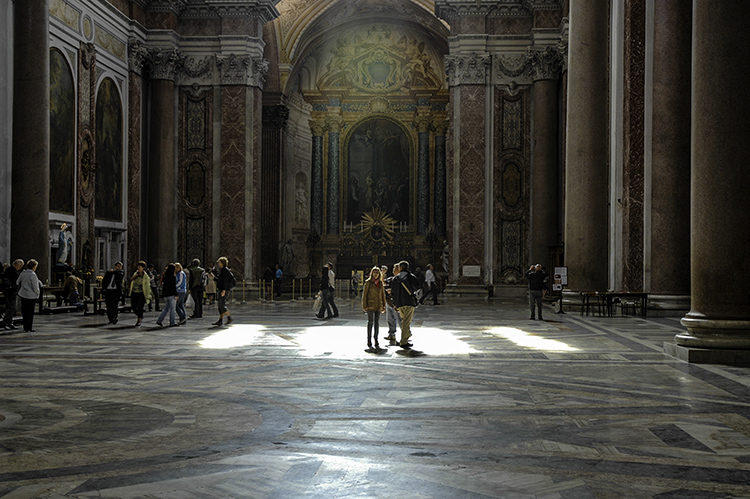
Santa Maria degli Angeli e dei Martiri: A church built within the ruins of the Baths of Diocletian. We visited this church when we were at the National Roman Museum, as it is all inter-mingled. It is surprise when you walk past the exterior of the baths.
Celio includes the Caelian Hill, known for its quiet charm.
Basilica of Saints John and Paul: I have this on my list of things to explore, because it is in an area below the Colosseum, so it is quite off the track of most sights in the historic centre. But the basilica is known as the ‘church of the chandeliers’, which diffuse spectacular light effects on the inside.
Roman Houses of the Celio Hill are just a one minute walk from the Basilica of Saints John and Paul. It is described as an extraordinary archaeological complex that contains more than four centuries of history and bears witness to the passage and coexistence of paganism and Christianity. There are the remains of Roman houses compelte with frescoes.
Basilica of the Santi Quattro Coronati: We went here a number of years ago to see the cloisters. A real medieval fortress in the center of Rome. It is in the area of the two places above, but almost 1 km walk from the Basilica of Saints John and Paul.
Arch of Dolabella and Silano: One of the only two gates still standing in the Servian Walls. One year, after seeing a photo exhibition of the Aurilian Walls, I took a cab to the newer, further out, walls. The Servian Walls are older original walls of Rome. The Aurilian Walls were built to protect an expand area of Rome. This seems like a future outing on our next trip.
Testaccio is known for its food scene and vibrant nightlife.
Cimitero Acattolico: The Non-Catholic Cemetery, the resting place of Keats and Shelley is a large cemetery in Rome near the Porta San Paolo and adjacent to the small-scale Egyptian-style pyramid build between 18 and 22 BC. We spent an afternoon here and enjoyed the peace and quite. Time Out magazine says go for the sheer atmosphere. The headstones and tombs are very interesting. Open 9-5, Monday to Saturday.
San Saba lies south of the Aventine Hill.
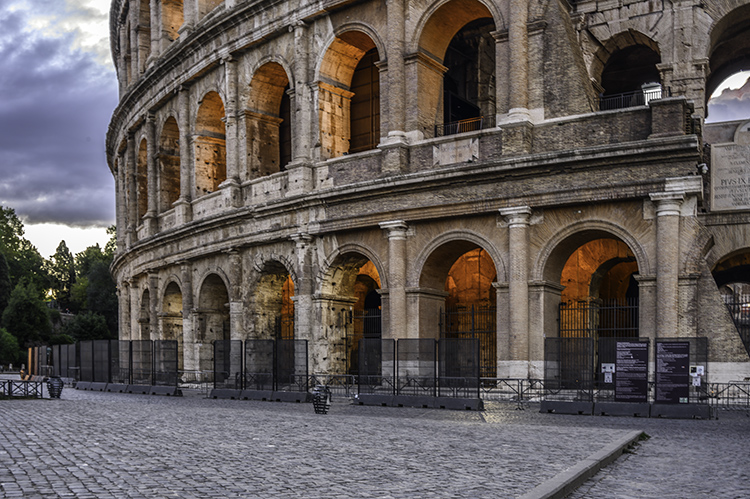
Baths of Caracalla: Ruins of an ancient Roman bath complex. I enjoyed going through the massive structure of walls and arches that remain. You get the feeling of being in an ancient site without the crowds.
San Saba Basilica: A lesser-known gem with beautiful mosaics.
Aventine Keyhole: Peek through to see a framed view of St. Peter’s Basilica.
Piramide Cestia: An ancient pyramid-shaped tomb.
Prati is adjacent to Vatican City.
We stayed in the area for a number of visits. Unfortunately the apartment we rented was taken off the market. The Piazza Cavour feels like real Rome. It is just a few blocks from major sites like the Castel San'Angelo but not impacted as much byu tourism.
Via Cola di Rienzo: is a bustling shopping street noted in many guides but having walked it many times I just call it an interesting pleasant street to walk.
Select thumbnail to see larger image
MARCUS TRAVEL JOURNAL
My Travel Journal

© Glenn Marcus
All Rights Reserved